Atlas · Plate IV · Scientific Basis
Physiology
Physiology is how the healthy body works, and in the dental chair it shows up as numbers you record and decisions you make from them: blood pressure, pulse, respirations, glucose, bleeding risk and salivary flow. The area covers the cardiovascular, respiratory, endocrine and nervous systems, blood and hemostasis, saliva, and kidney and digestive function.
On the NBDHE these facts appear in the Scientific Basis section and again in case questions about whether care can go ahead. Know the ACC/AHA 2017 blood pressure categories and the reading that means deferring elective care, normal adult vital sign ranges, how warfarin is monitored with the INR, how fasting glucose and HbA1c define diabetes, and how saliva protects the teeth.
Blueprint Scientific Basis for Dental Hygiene Practice · Physiology · 39 facts

In this plate, we cover
01 · 7 facts
Cardiovascular system and vital signs
Blood pressure is graded by the ACC/AHA 2017 categories: normal under 120/80, elevated at 120-129 systolic, stage 1 at 130-139 or 80-89, stage 2 at 140/90 or higher, and crisis above 180/120, which calls for deferring care and referring. Use a correctly sized cuff, because one that is too small reads falsely high. A normal adult pulse is 60-100 beats per minute.
- Blood pressure categories (ACC/AHA 2017): normal under 120/80; elevated 120-129/under 80; stage 1 130-139 or 80-89; stage 2 140 or higher or 90 or higher.S27
- Hypertensive crisis is above 180 and/or above 120 diastolic; treat as urgent and refer.S27
- Use a cuff whose bladder covers at least 80% of the arm's circumference; a cuff that is too small reads falsely high.S27
- Normal adult resting pulse is 60-100 beats/min; under 60 is bradycardia, over 100 tachycardia.S49
02 · 4 facts
Respiratory system
A healthy adult breathes 12-20 times a minute, and children breathe faster. The medulla sets the rate mainly in response to carbon dioxide in the blood, and normal oxygen saturation is about 95-100%. Patients with COPD may depend on low oxygen to drive their breathing, so seat them upright and give oxygen only at a low flow.
- Normal adult respiratory rate is 12-20 breaths per minute; children are faster.S49
- The medulla oblongata controls breathing rate mainly in response to blood CO2.S49
- Normal oxygen saturation (SpO2) is about 95-100%.S49
- COPD patients may rely on low oxygen as a breathing drive; give oxygen cautiously (low flow) and seat them upright.T8
03 · 6 facts
Endocrine system
Insulin from pancreatic beta cells lowers blood glucose, and glucagon from alpha cells raises it. Diabetes is diagnosed by a fasting glucose of 126 mg/dL or higher, an HbA1c of 6.5% or higher, or a random glucose of 200 mg/dL with symptoms. Long-term steroid use can lead to adrenal crisis under stress, and uncontrolled hyperthyroidism limits vasoconstrictor use.
- Insulin from pancreatic beta cells lowers blood glucose; glucagon from alpha cells raises it.S49
- Normal fasting plasma glucose is under 100 mg/dL; 100-125 is prediabetes; 126 or higher (on two tests) is diabetes.S28
- HbA1c reflects about 2-3 months of glucose control: under 5.7% normal, 5.7-6.4% prediabetes, 6.5% or higher diabetes.S28
- A random glucose of 200 mg/dL or higher with classic symptoms also diagnoses diabetes.S28
04 · 6 facts
Blood and hemostasis
Bleeding stops in stages: the vessel constricts, platelets form a plug, the coagulation cascade builds fibrin, and fibrinolysis later clears the clot. Vitamin K is needed for clotting factors II, VII, IX and X, which is why warfarin works and why it is monitored by INR, usually kept at 2-3. Hemophilia A and B are deficiencies of factors VIII and IX.
- Normal adult platelet count is about 150,000-450,000 per microliter.S49
- Hemostasis steps: vascular spasm, platelet plug, coagulation cascade, then fibrinolysis.S49
- Vitamin K is needed for clotting factors II, VII, IX and X; warfarin blocks vitamin K recycling.S49S51
- INR around 1.0 is normal; the usual therapeutic range on warfarin is 2-3 (2.5-3.5 for some mechanical valves).S57
05 · 7 facts
Saliva
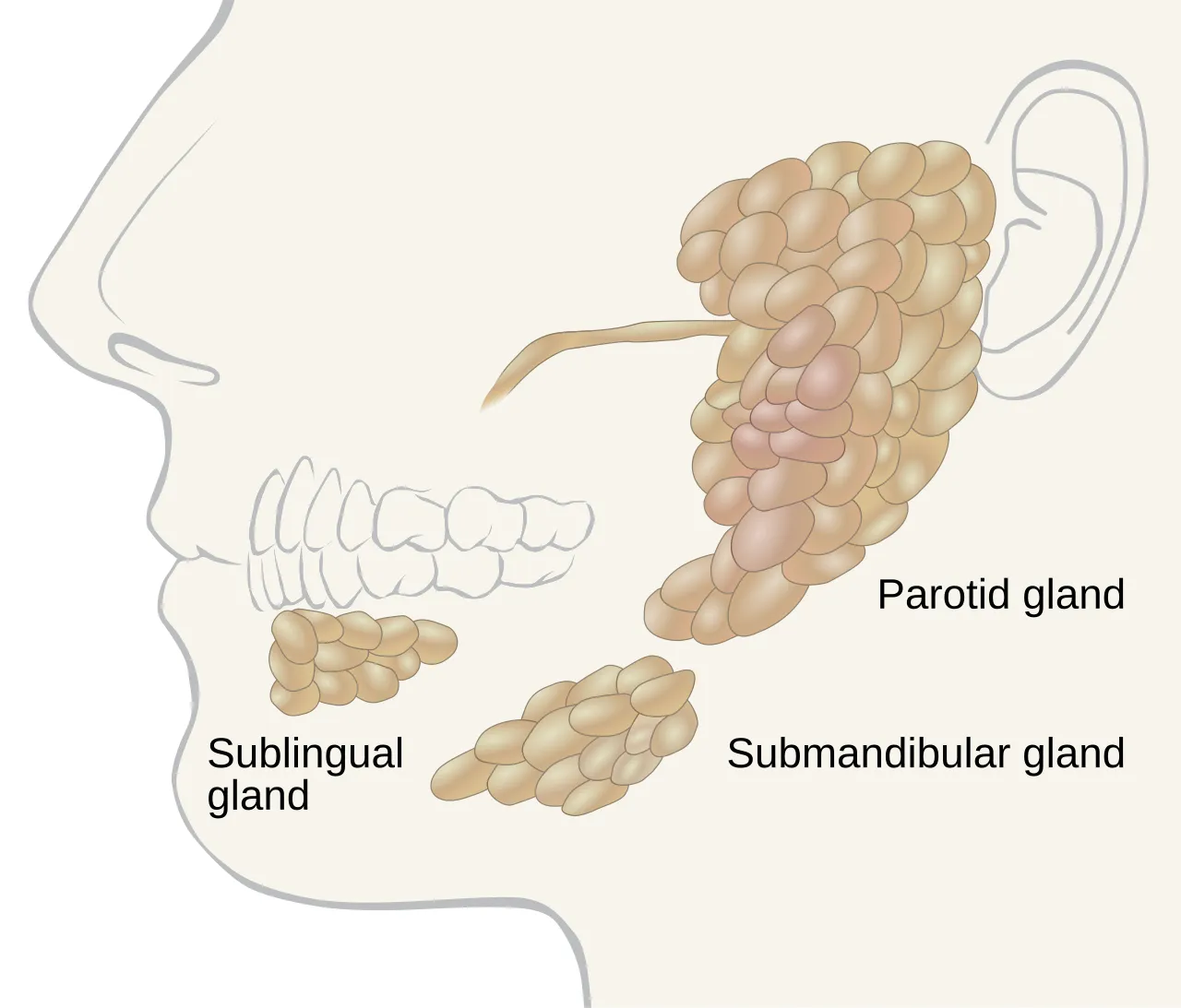
Adults make about 1-1.5 L of saliva a day. At rest the submandibular gland supplies most of it, while the parotid dominates when flow is stimulated. Saliva buffers acid, mainly with bicarbonate, starts starch digestion with amylase and fights microbes with IgA, lysozyme and lactoferrin. An unstimulated flow under 0.1 mL per minute counts as hyposalivation.
- Daily saliva output is roughly 1-1.5 L.S44
- Unstimulated flow comes mostly from the submandibular gland (about 60-70%); stimulated flow is dominated by the parotid.S44
- Normal unstimulated whole saliva is about 0.3-0.4 mL/min; under 0.1 mL/min is hyposalivation.T2
- Normal salivary pH is about 6.2-7.6; bicarbonate is the main buffer.S44
06 · 6 facts
Nerve and muscle
The sympathetic system drives fight or flight, raising heart rate and blood pressure, while the parasympathetic system handles rest and digest. Receptor types explain many drug effects: alpha-1 narrows vessels, beta-1 speeds and strengthens the heart, and beta-2 opens the airways. Local anesthetics block sodium channels, so small pain fibers go numb before touch, pressure and motor fibers.
- The sympathetic system is "fight or flight" (raises heart rate and BP); the parasympathetic is "rest and digest."S49
- Acetylcholine is the main parasympathetic neurotransmitter; norepinephrine is the main sympathetic one.S49
- Alpha-1 receptors constrict vessels; beta-1 receptors raise heart rate and force; beta-2 receptors dilate bronchi.S51
- Local anesthetics block voltage-gated sodium channels, stopping nerve impulse conduction.S14
07 · 3 facts
Kidney and digestion
The kidneys clear most drugs and their breakdown products, so kidney disease can call for dose changes. Patients on hemodialysis are usually given heparin, so schedule dental care on a day without dialysis. Stomach acid has a pH of about 1.5-3.5, and reflux (GERD) can erode the palatal surfaces of the maxillary teeth.
- The kidneys excrete most drugs and their metabolites; kidney disease may require dose changes.S51
- Patients on hemodialysis are typically heparinized; schedule dental care on a non-dialysis day.T8
- Gastric acid has a pH of about 1.5-3.5; GERD can cause erosion on palatal surfaces of maxillary teeth.S49T5
Watch